PPT Chapters 11 and 12 IR & NMR Spectroscopy, Identification of Unknowns PowerPoint
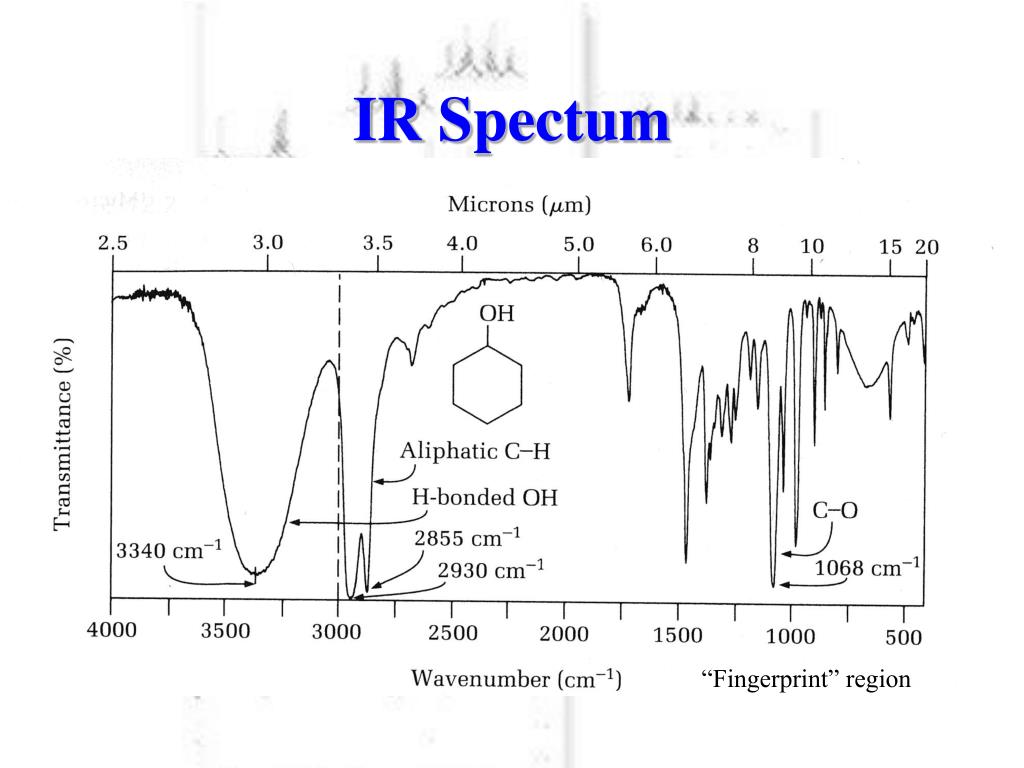
Jump To. Infrared (IR) spectroscopy in the so-called "fingerprint" mid-IR region of wavelengths (from 1500 to 600 cm -1) is a useful tool in a variety of applications. (1) This region contains fundamental molecular vibrational bands, such as the C-O, C-C, and C-N stretches, the C-H bending vibrations, and some benzene ring signatures.
IR (Infrared spectroscopy) Fingerprint — University of Northampton's Research Explorer

The importance of the fingerprint region is that each different compound produces a different pattern of troughs in this part of the spectrum. Compare the infra-red spectra of propan-1-ol and propan-2-ol. Both compounds contain exactly the same bonds. Both compounds have very similar troughs in the area around 3000 cm -1 - but compare them in.
Ir Spectrum Table Fingerprint Region
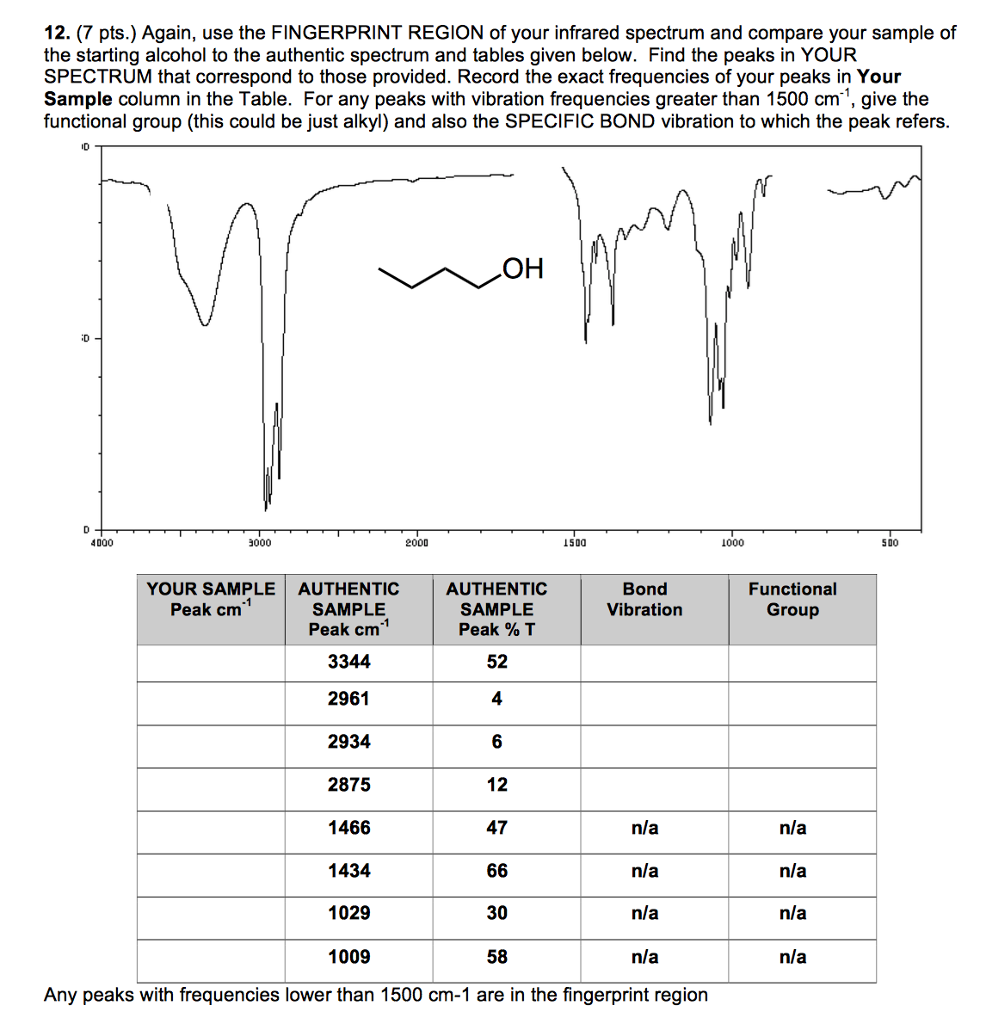
Lesson 1: Infrared spectroscopy. Introduction to infrared spectroscopy. Bonds as springs. Signal characteristics - wavenumber. IR spectra for hydrocarbons. Signal characteristics - intensity.. Well the fingerprint region is the single-bond region (which doesn't include bonds to hydrogen) and so this region would be characteristic to a.
IR (Infrared Spectroscopy) (ALevel) ChemistryStudent
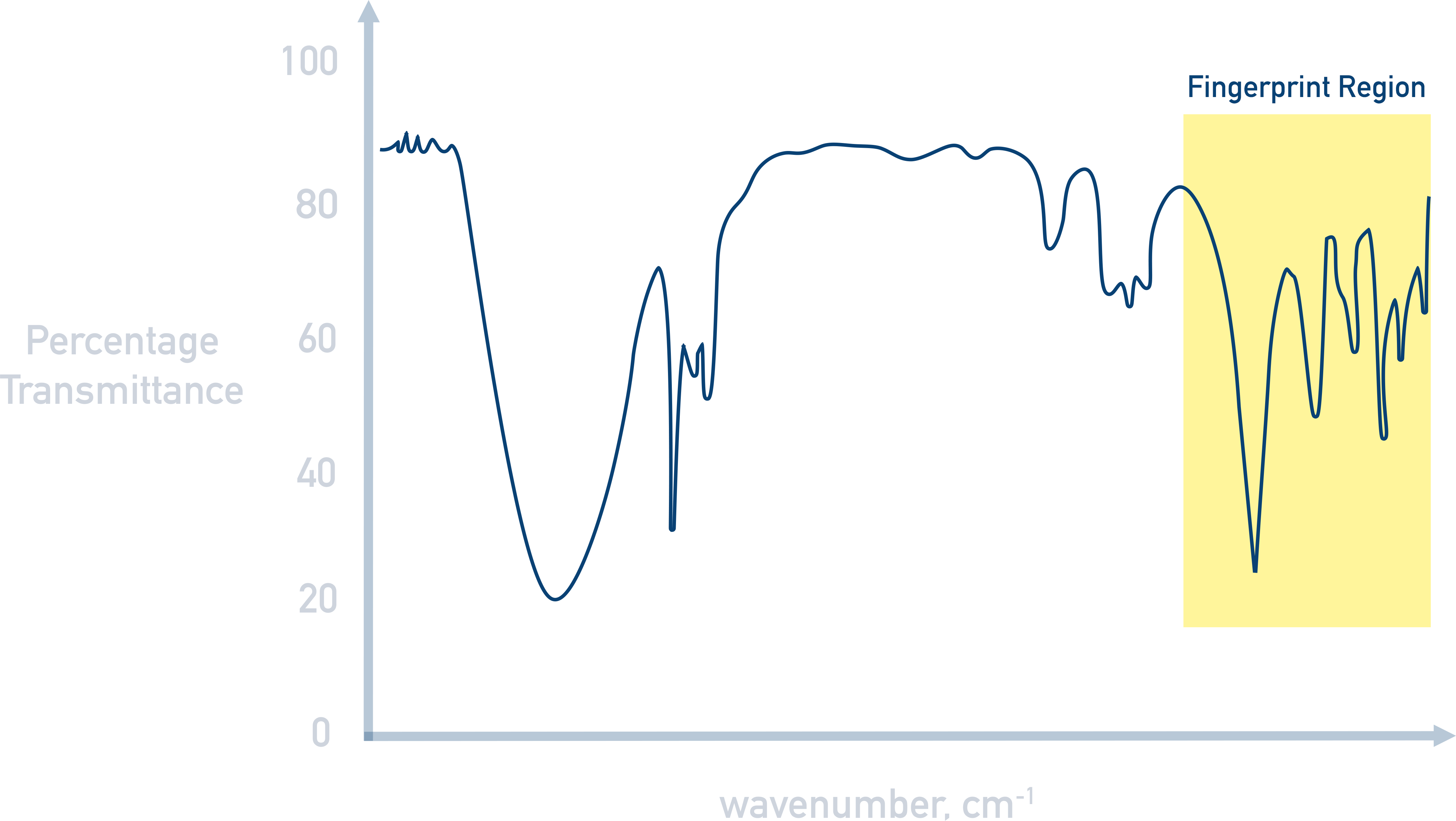
What is the fingerprint region. This is a typical infra-red spectrum: Each trough is caused because energy is being absorbed from that particular frequency of infra-red radiation to excite bonds in the molecule to a higher state of vibration - either stretching or bending. Some of the troughs are easily used to identify particular bonds in a.
Ir Spectrum Table Fingerprint Region Elcho Table

Infrared spectroscopy (IR spectroscopy or vibrational spectroscopy) is the measurement of the interaction of infrared radiation with matter by absorption,. In the fingerprint region there are many troughs which form an intricate pattern which can be used like a fingerprint to determine the compound.
Ir Spectroscopy Table Fingerprint Region Bios Pics
Each compound's IR spectrum is unique and so, by matching a spectrum to a library or database either electronically or by eye, it can be positively identified. Such methods are used in forensic, analytical and environmental applications as well as in research chemistry. The IR spectra of the two isomers of C 4 H 10, methylpropane and butane.
Infrared spectra of the fingerprint region (1800700 cm − 1 ) of... Download Scientific Diagram

Figure 3. Inferring molecular assembly from infrared spectroscopy. (A) xTB-calculated IR spectrum of 5-aminoisophthalic acid with highlighted fingerprint region (400-1500 cm -1). (B) Example of the six most intense vibrational bands in the fingerprint region, demonstrating its collective-motion nature.
PPT IR spectroscopy PowerPoint Presentation ID2458620

Harnessing vibrational fingerprint, IR spectroscopy offers a solution for non-invasive, non-destructive, label-free, and real-time recognition and monitoring of molecules, especially in the mixture.
The diagnostic fingerprint regions of the FTIR spectra of raw and... Download Scientific Diagram

Bands that are unique to each molecule, similar to a fingerprint, are found in the fingerprint region, from 1300 cm-1 to 400 cm-1. These bands are only used to compare the spectra of one compound to another. Samples in Infrared Spectroscopy. The samples used in IR spectroscopy can be either in the solid, liquid, or gaseous state.
Experimental and simulated IR spectra of nucleobases in the fingerprint... Download Scientific

These types of infrared bands are called group frequencies because they tell us about the presence or absence of specific functional groups in a sample. Figure 2. Group frequency and fingerprint regions of the mid-infrared spectrum. The region of the infrared spectrum from 1200 to 700 cm-1 is called the fingerprint region. This region is.
Finger Print Region(IR Spectroscopy) Dr.S.S.Chauhan YouTube

The results reveal that the fingerprint peak in the enhanced fingerprint spectrum is formed by the linked envelope. It exhibits a significant enhancement factor exceeding 64-fold in the terahertz region and more than 55-fold in the mid-infrared region. Particularly, the corresponding identification limit of 2,4-DNT is 1.32 µg cm−2, respectively.
Infrared spectra of the fingerprint region (1800700 cm − 1 ) of untreated Download Scientific

1. Introduction. The origins of infrared (IR) spectroscopy date back to 1800, when the astronomer William Herschel discovered the infrared region of the electromagnetic spectrum positioned beyond the red limit of the visible band [].Vibrational spectroscopy provides structural information in both qualitative and quantitative analyses of practically any compound.
Fingerprint region of FTIR spectrum of the peruphasmal sample. Download Scientific Diagram

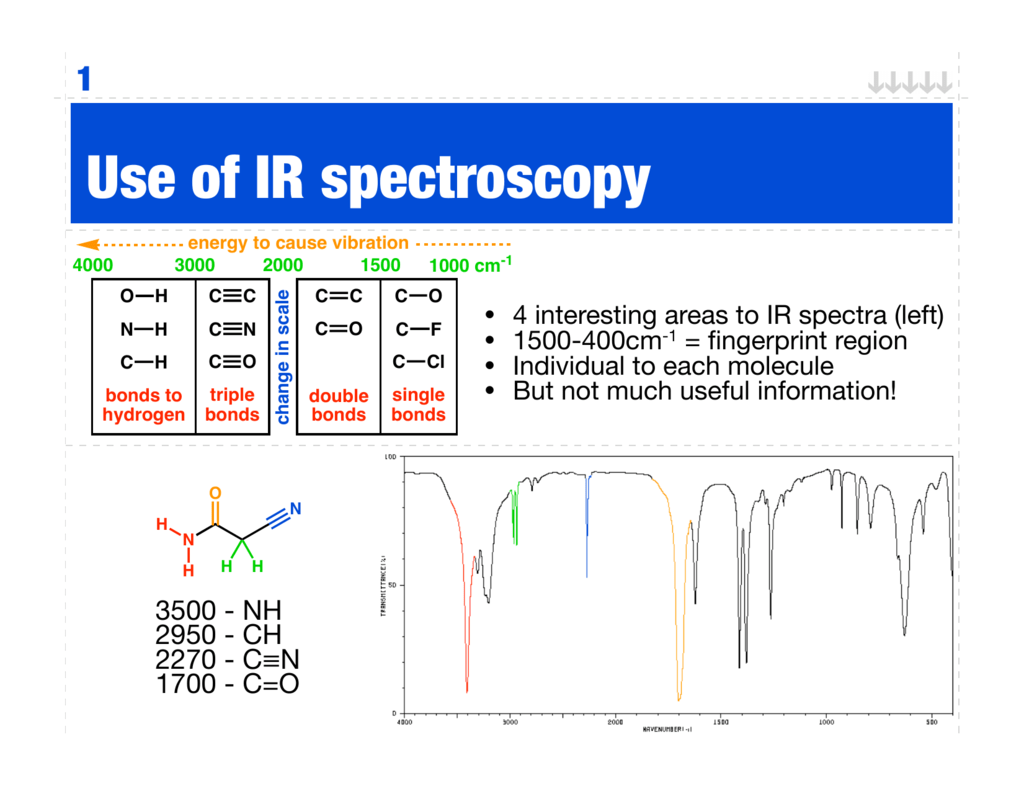
THE FINGERPRINT REGION Although the entire IR spectrum can be used as a fingerprint for the purposes of comparing molecules, the 600 - 1400 cm-1 range is called the fingerprint region. This is normally a complex area showing many bands, frequently overlapping each other. This complexity limits its use to that of a fingerprint, and should be.
FTIR spectra of the fingerprint region for Miscanthus and Miscanthus... Download Scientific

In this video I (Dr. Anjali Ssaxena) have explained Finger print and functional group region in IR spectroscopy.Access the playlist of spectroscopy:https://w.
Enlargements of the IR spectra in the fingerprint region (a,c,e,g) for... Download Scientific
Spectroscopy in the molecular fingerprint spectral region (6.7-20 µm) yields critical information on material structure for physical, chemical, and biological sciences. Despite decades of interest and effort, this portion of the electromagnetic spectrum remains challenging to cover with conventional laser technologies. In this paper, we present a simple and robust method for.
6 Graph A) represents the fingerprint region of the FTIR spectrum at... Download Scientific

The region from 2000 to 1500 cm -1 is where double bonds (C═O C═O, C═N C═N, and C═C C═C) absorb. Carbonyl groups generally absorb in the range 1680 to 1750 cm -1, and alkene stretching normally occurs in the narrow range of 1640 to 1680 cm -1. The region below 1500 cm -1 is the fingerprint portion of the IR spectrum. A large.